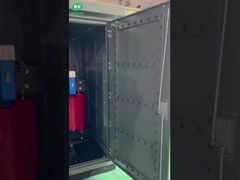
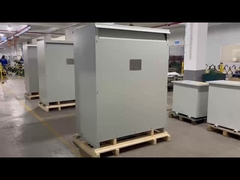
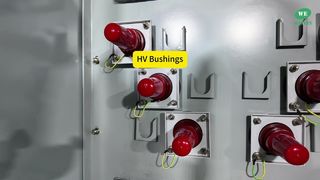
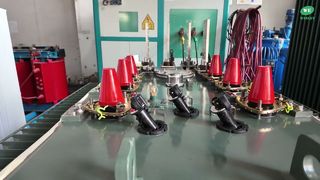
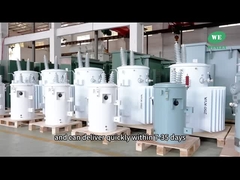
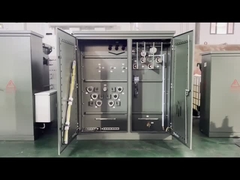
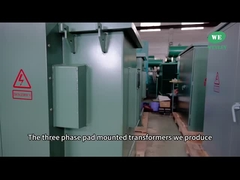
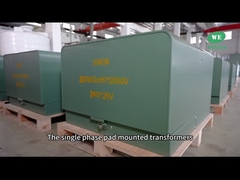
Brief: In this video, we provide an informative walkthrough of the 225kVA Cast Coil Transformer. You'll see its robust NEMA 3R enclosure, explore the internal cast resin construction, and learn how its design meets DOE 2016, IEEE, and ANSI standards for reliable, high-efficiency performance in demanding applications.
Related Product Features:
Dry-type, cast resin construction eliminates oil and provides superior environmental safety.
High-efficiency 225 kVA transformer designed to meet DOE 2016, IEEE, and ANSI standards.
Three-phase operation with 12470Y/7200V primary to 480Y/277V secondary voltage conversion.
Weatherproof NEMA 3R steel enclosure allows for reliable indoor or outdoor installation.
Class F insulation and aluminum windings ensure durable performance and thermal resilience.
Forced-air cooling (AN/AF) maintains optimal operating temperatures under load.
Low noise operation at 56 dBA makes it suitable for noise-sensitive environments.
Compact design reduces installation costs by enabling placement closer to electrical loads.
FAQs:
What are the key advantages of the cast resin construction in this transformer?
The cast resin construction provides strong short-time overload capacity, is moisture and contamination resistant for outdoor use, has low fire risk with self-extinguishing materials, and is environmentally friendly with no oil required.
Is this transformer suitable for outdoor installation?
Yes, it features a weatherproof NEMA 3R steel enclosure that protects against rain, sleet, and external ice formation, making it ideal for both outdoor pad mounting and indoor floor installations.
What efficiency standards does this 225kVA transformer comply with?
This transformer is built to meet DOE 2016 efficiency regulations, along with IEEE and ANSI standards, achieving 99.00% efficiency with low no-load and full-load losses.
How does this transformer handle demanding industrial conditions?
It features robust construction with high impact tolerance, vibration-capable operation for heavy machinery environments, and forced-air cooling to maintain performance under continuous load.